
Cleanroom Design for Electronics Assembly: Particle Control, ESD and Modular Work Zones
TECHNICAL ARTICLE | ELECTRONICS ASSEMBLY
Cleanroom Design for Electronics Assembly: Particle Control, ESD and Modular Work Zones
A circuit board can look clean while its components are exposed to particles, handling damage and electrostatic discharge. The right controlled environment starts with the assembly process, then connects airflow, enclosure details and ESD practices to measurable requirements.
The close-up image below shows an integrated circuit mounted on a board. It is an illustration of the type of delicate product that may pass through electronics assembly, inspection or test. The image does not establish the cleanliness level of a facility or the requirements of a particular production line. Those decisions depend on the product, process steps and failure modes.

Define the Critical Steps Before Selecting an ISO Class
Electronics manufacturing covers very different operations. A semiconductor clean room used for wafer processing is not interchangeable with a controlled zone for board assembly, component packaging or final inspection. Open devices, exposed bonding surfaces, optical parts and unsealed subassemblies may have different sensitivities to airborne particles or surface contamination. Some stages need a room-wide controlled environment; others may be better served by a local clean zone around the tool.
Start by mapping when the product is exposed, how long it remains exposed, where people and materials cross the boundary, and which defects the process is trying to prevent. This process map should lead the cleanliness target. ISO 14644-1 classifies air cleanliness by airborne particle concentration; it does not, by itself, specify product yield, surface cleanliness or ESD protection.
Design principle: define acceptance criteria for each sensitive step first. Then decide whether the boundary should surround an entire room, a production cell or a single piece of equipment.
Make Supply Air, Returns and Equipment Heat Work Together
Filtered supply air must reach the work area without short-circuiting directly to a return path. Equipment racks, tall enclosures and operator stations can block the intended flow. Heat from machinery can also change local air movement. An FFU ceiling grid can support flexible fan filter unit placement, but the grid layout should be coordinated with lights, sprinklers, cable routes, access panels and maintenance clearance before fabrication.
A cleanroom ceiling system is part of the airflow and service strategy, not simply a finished surface. Ceiling penetrations need defined sealing details. Return air paths should be visible on the drawings and checked against equipment placement. If the process changes later, modular ceiling zones can make reconfiguration easier, provided the structure, electrical supply and controls were planned for it.
Use a Modular Boundary That Can Be Cleaned and Maintained
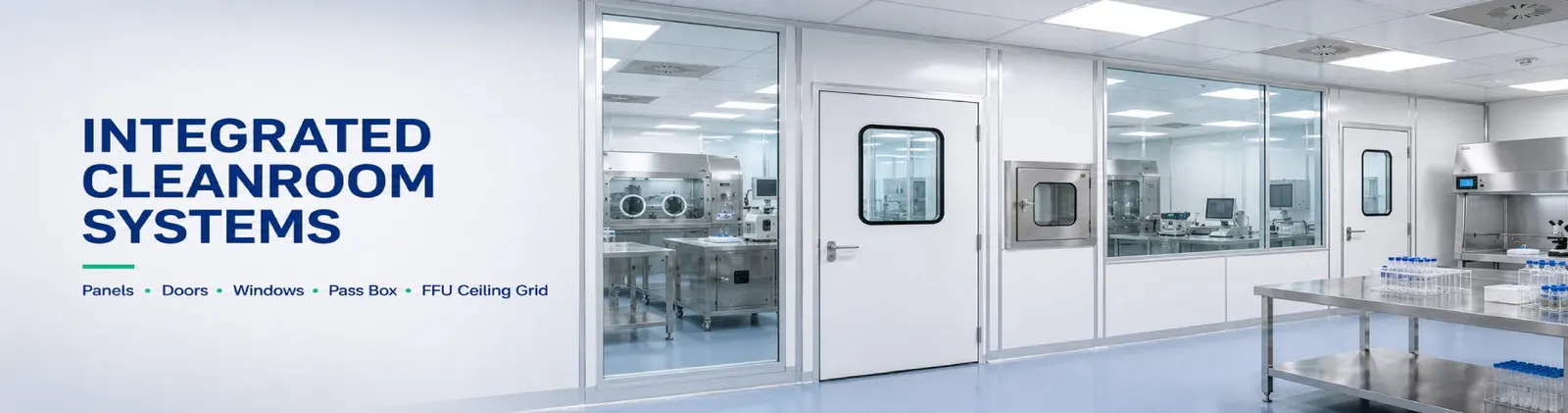
A modular cleanroom enclosure can separate sensitive assembly steps from adjacent circulation, packaging or service areas. The useful details are practical: flushable joints, sealed service penetrations, accessible inspection points, door hardware that fits material flow, and window positions that allow observation without unnecessary entry. Cleanroom wall panels should be selected as part of that system, with their joints and interfaces coordinated with the ceiling, floor and equipment services.
Pass-through points and doors deserve the same attention as the main wall. Every transfer creates an opportunity for particles to enter and for operators to interrupt the intended pressure relationship. The layout should let components move through receiving, preparation, assembly and inspection with a clear route and a manageable number of boundary crossings.
Pair Particle Control With an ESD Program
Air cleanliness and electrostatic discharge are related to product protection, but they are different engineering controls. Filtered air cannot replace grounding, appropriate work surfaces, handling rules, packaging and verification of ESD controls. Materials chosen for walls, flooring, furniture and transport should be reviewed together with the site's ESD program so that cleanable surfaces do not create an unmanaged static risk.
ANSI/ESD S20.20-2021 provides requirements for establishing, implementing and maintaining an ESD control program for electronic parts and assemblies. The project's ESD specialists should set the protection level and verification plan based on the devices handled. An ISO air classification should never be presented as proof of ESD compliance.
Decisions to Lock Before Panel and Ceiling Fabrication
| Design item | Question to resolve | Evidence to collect |
|---|---|---|
| Critical process | Where is the component exposed, and for how long? | Process map, product risk assessment and agreed acceptance criteria. |
| Airflow | Where will filtered air enter and leave around actual equipment? | Airflow drawings, commissioning tests and operational observations. |
| Modular boundary | How will doors, glazing and penetrations stay cleanable and sealed? | Approved details, inspection records and maintenance access review. |
| ESD protection | Which parts are sensitive, and which controls are required? | ESD control plan and routine verification records. |
| Future changes | Can tools or work cells move without cutting finished panels? | Spare service capacity and documented change procedure. |
Commission the Environment Under Real Operating Conditions
ISO 14644-4:2022 addresses cleanroom design, construction and start-up. ISO 14644-2:2015 addresses monitoring plans that provide evidence of performance related to airborne particle concentration. A handover plan should connect those principles to the site's actual process: classification and relevant tests, airflow behavior with installed equipment, pressure relationships where specified, maintenance access and operator practices.
Testing an empty room is only one part of the story. Machines, personnel, materials and cleaning routines can change conditions at the work point. The project team should define which occupancy states matter, where measurements will be taken and what actions follow an out-of-limit result. No specific ISO class, air-change rate or yield improvement can be claimed from the illustrative photograph alone.
Avoid These Electronics Cleanroom Planning Gaps
- Copying a wafer-fab specification: use the product and process risk assessment to set the requirement for each assembly step.
- Placing FFUs before equipment layout is fixed: tool height, heat and maintenance access can alter the useful airflow pattern.
- Treating cleanable surfaces as ESD controls: specify and verify particle and static controls separately.
- Forgetting service penetrations: late cable or utility cuts can compromise the enclosure boundary.
- Checking only an empty room: include the agreed operational conditions in the verification plan.
Electronics Assembly Cleanroom FAQ
Does every electronics assembly line need a classified cleanroom?
No. The appropriate control depends on the sensitivity of the exposed product and process. Some steps may need a local clean zone; others may justify a room-wide classified environment.
Can an FFU ceiling grid solve a poor room layout?
No. Fan filter units must be coordinated with returns, equipment, heat sources, access and the enclosure boundary. Grid flexibility helps only when the overall airflow strategy is sound.
Does ISO 14644 classification cover ESD?
No. ISO 14644-1 classifies airborne particle concentration. ESD protection requires its own program, controls and verification.
What makes a modular enclosure useful for changing production lines?
Planned panel joints, service routes, ceiling interfaces and spare capacity can allow work cells to change with less disruption, subject to a new risk review and verification.
Planning an electronics cleanroom? Wonclean can discuss modular wall and ceiling interfaces, fan filter unit grid coordination, doors and service penetrations around your equipment layout. Share the process flow, product sensitivity and target performance so the enclosure can be designed around the real work.